
Reading a text message, recognizing a familiar face, driving, and seeing fine detail all depend heavily on the macula, a small but important area in the center of the retina.
Age-related macular degeneration, or AMD, affects this area and can gradually interfere with central vision.
Because early AMD may cause few noticeable symptoms, awareness is especially important for adults approaching or beyond age 50.
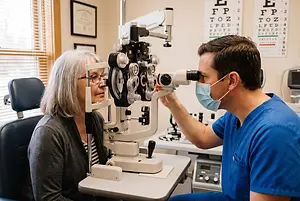
Today’s Vision 380 screens for macular degeneration as part of its comprehensive eye care and uses advanced retinal imaging to help identify and monitor changes.
What Does the Macula Do?
The retina is the light-sensitive tissue at the back of the eye.
At its center is the macula, which is responsible for sharp, detailed vision.
When the macula is damaged, you may have difficulty seeing the object directly in front of you while your peripheral vision remains relatively intact.
This is why AMD typically affects central vision rather than causing total blindness.
Dry AMD and Wet AMD Are Different
AMD occurs in two main forms.
Dry AMD is more common and generally progresses gradually. Small deposits called drusen may accumulate beneath the retina, and the macular tissue can thin over time.
Wet AMD is less common but can progress much faster. It develops when abnormal blood vessels grow beneath the retina and leak fluid or blood.
A person with dry AMD can later develop wet AMD, making ongoing monitoring important.
Early Symptoms Can Be Easy to Miss
AMD may initially cause no obvious symptoms.
As it progresses, you may notice blurred central vision, difficulty reading fine print, straight lines appearing wavy, dark or empty spots in your central vision, reduced contrast, colors appearing less vivid, and greater difficulty recognizing faces.
A sudden change in central vision should be evaluated promptly.
Who Is at Greater Risk for AMD?
Age is one of the strongest risk factors, particularly after 50.
Other factors may include smoking, family history, high blood pressure, cardiovascular disease, obesity, and certain genetic factors.
You cannot control your age or genetics, but you can address several lifestyle-related risks.
Healthy Habits Can Support Macular Health
There is no guaranteed way to prevent AMD, but healthy choices can support both eye and cardiovascular health.
Consider avoiding smoking, staying physically active, managing blood pressure and cholesterol, eating leafy greens, colorful vegetables, fish, nuts, and whole foods, wearing sunglasses with reliable UV protection, and attending regular comprehensive eye exams.
Today’s Vision 380 also offers outdoor lenses and sunglasses designed to provide sun protection and reduce visual discomfort outdoors.
Retinal Imaging Can Reveal More Than a Vision Chart
AMD affects structures inside the eye, so reading an eye chart alone is not enough to assess macular health.
Today’s Vision 380 uses OCT retinal imaging to produce high-resolution scans of retinal structures. Retinal photography and other diagnostic tools can also help Dr. Cheng document changes and compare findings over time.
These tests can provide valuable information even before a patient notices major changes in vision.
What About AREDS2 Supplements?
Some patients diagnosed with specific stages of AMD may benefit from a particular combination of vitamins and antioxidants known as the AREDS2 formula.
These supplements are not intended for everyone and are not a general prevention strategy.
Always ask your eye doctor before starting a supplement marketed for macular health.
Protect the Vision You Use Most
Central vision plays a major role in independence, work, driving, and everyday life.
If you are over 50, have a family history of macular degeneration, or have noticed new distortion or central blur, schedule a comprehensive eye exam at Today’s Vision 380 in Frisco, TX.
Regular monitoring gives Dr. Cheng the opportunity to identify changes early and guide the next steps if AMD develops.
Frequently Asked Questions
Does macular degeneration cause complete blindness?
- AMD primarily affects central vision. Peripheral vision is usually preserved, although advanced disease can still significantly affect independence and daily activities.
Can you have AMD without knowing it?
- Yes. Early AMD can develop without noticeable symptoms, which is why regular eye exams and retinal evaluation are important.
Why do straight lines look wavy with AMD?
- Changes in the macula can distort the way images are processed, causing straight edges or grid lines to appear bent or wavy.
Can wet AMD be treated?
- Yes. Wet AMD can often be managed with medications that target abnormal blood vessel growth and leakage. Prompt diagnosis is important.
Do I need retinal imaging at every visit?
- Not necessarily. Your eye doctor will recommend imaging based on your age, risk factors, symptoms, medical history, and previous findings.